Friday, May 31, 2013
graduation
One reason the blog has been a little bit quiet lately is because I just graduated from college. (Don't worry, there was an elevator to get downstairs!)
I'm taking some time off this summer, but I'll keep you posted on what's up next for me :)
Wednesday, May 1, 2013
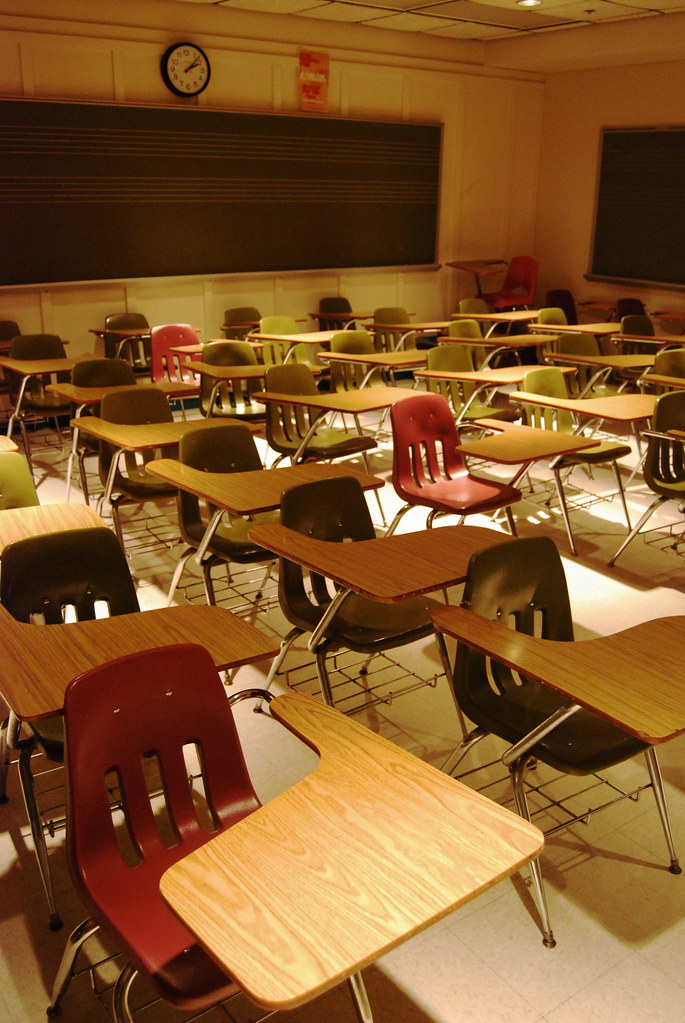
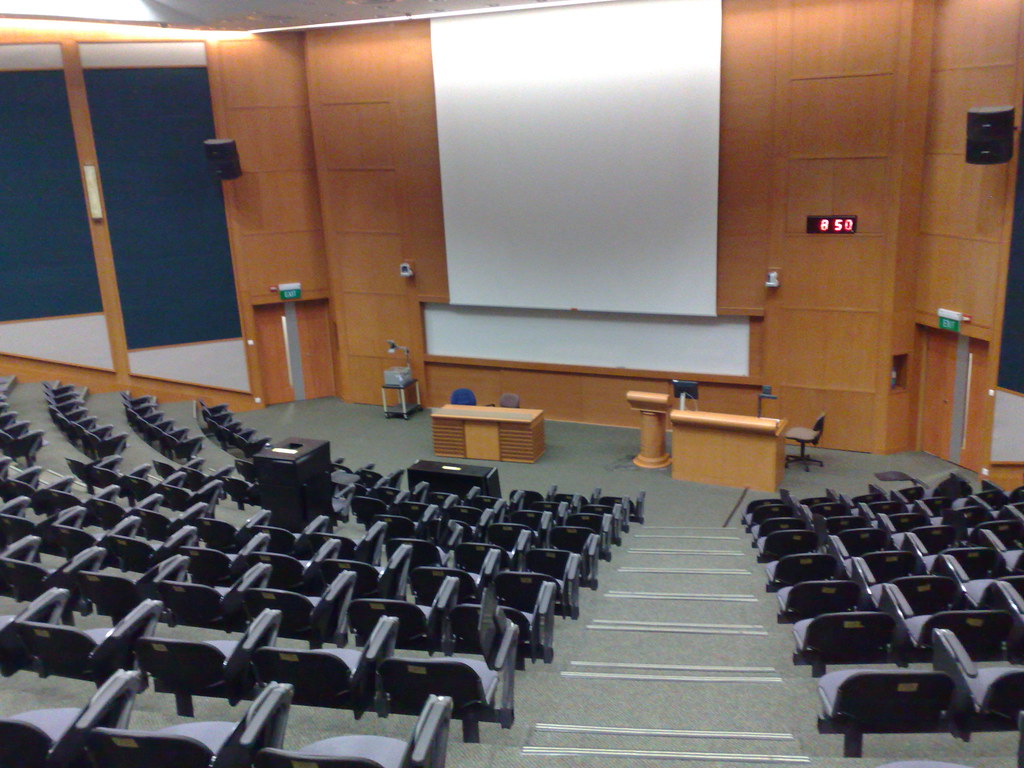
how to make an accessible space: classroom edition
| photo: Seth Sawyers |
| Photo: Marijn de Vries Hoogerwerff |
- seats are attached and can't be moved
- seats have non-adjustable armrests, so people who require more room than the armrests allow won't be able to sit
- desks are attached to the seats, which is inconvenient for people who are left handed as well as for those who require more or less space between them and the writing surface. These desks are also usually a lot smaller, which means there is less room for assistive technology and other accommodations
- the vast majority of the seats are only accessible by stairs
- the doors don't appear to have buttons to open them
The barriers aren't only for people using wheelchairs. People with larger bodies or who are left handed might have to choose between sitting in an uncomfortable seat, or else asking to have a table and chair placed at the front of the class, where again they would be singled out and might have a harder time seeing. Somebody using crutches would also have a hard time with the stairs.
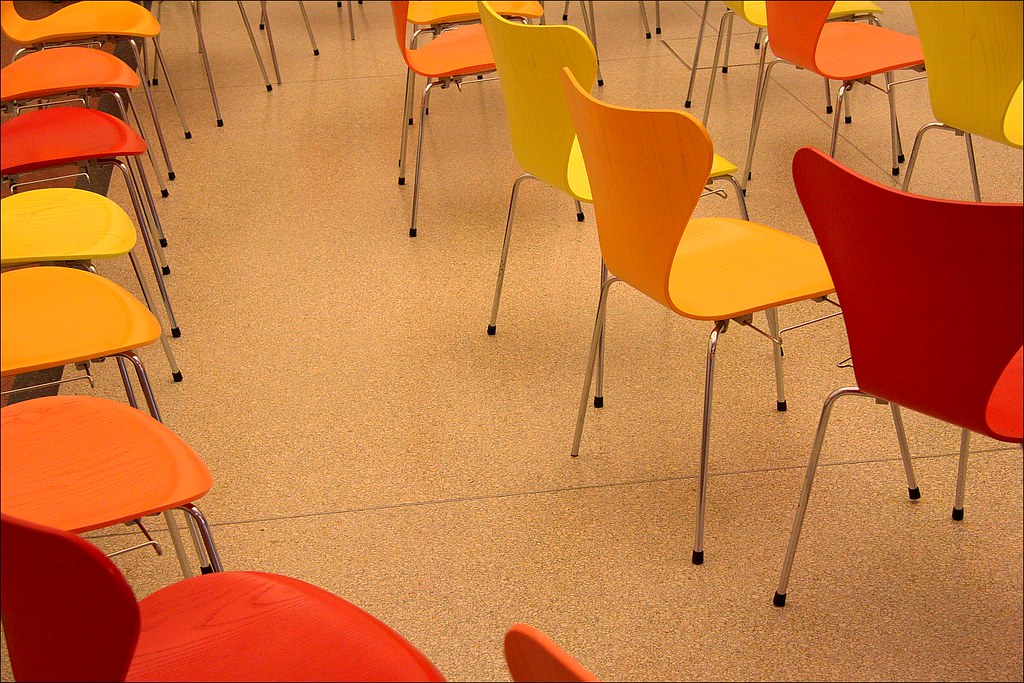
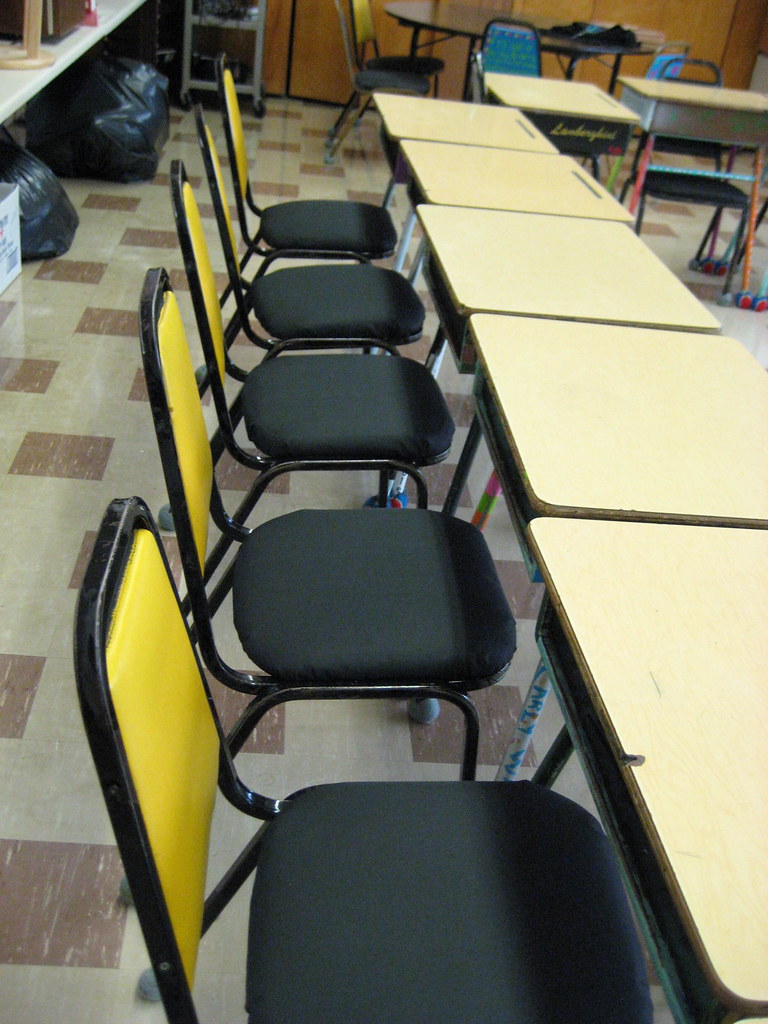
| Photo: velkr0 |
| photo: Rupert Ganzer |
| photo: Denise Krebs |
| Photo: James F Clay |
Here are some pictures I took of a lecture hall, and a few ideas to make it more accessible.
It has a ramp to get to the front of the classroom, which is a good thing. Unfortunately the desks and chairs are attached, and most of the rows of seats are only accessible by stairs.
You can see that there are some desks and chairs at the front of the room. People using wheelchairs could use these. But you can see that they would have to sit right at the front of the room, beside the professor, which is kind of awkward.
A better option might be to bring in a desk at the end of the row on the level of the exit. This way the person using the wheelchair could sit with their classmates. If it's not an option to renovate the whole room, even just removing one seat at the end of the row would give lots of space for a desk and chair.
Let's look at the first lecture hall again. What could be changed to make it more accessible, without completely renovating the whole room?
| Photo: Marijn de Vries Hoogerwerff |
- Install automatic door-opener buttons
- Remove a few of the seats in the front row and the back row, if there are exits there too, and bring in some tables/desks and chairs instead. Make sure the chairs are easy to move and don't have narrow armrests!
- If possible, turn one of the stairways into a ramp. You don't want it to be too steep. But this would let someone who uses a wheelchair and enjoys sitting in the back to use either the top or the bottom exit, and to speak to the professor after class.
Tuesday, November 27, 2012
how to make an accessible space: part two
At last, part two arrives! (See part one here). Here are some more pictures showing examples of accessibility and barriers to accessibility.
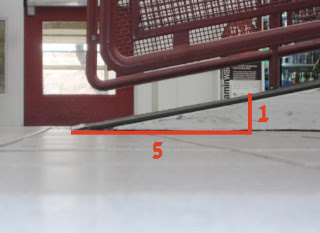
Ramps are an accessible alternative to stairs. However, not just any ramp will do. If ramps are too steep, it can be difficult or impossible for wheelchair users to use them.
The slope of a ramp in a public space should be no steeper than 4.8°, or a ratio of 1:12 (so for every inch of height, the ramp should be at least a foot long).
Do you think the ramp in the picture above is too steep or not?
Hmm, the angle is a lot greater than 4.8°...
And it turns out that the rise to run ratio is 1:5, not 1:12- this ramp is way too steep! This can be dangerous for people in wheelchairs.
Sometimes there isn't enough room to build a ramp that is long enough! An alternative solution is a stair lift or a platform lift. (This is a platform lift- it goes straight up and down. Stair lifts are platforms that move along the stairs.)
Many of these lifts require a key to operate- make sure that if it is in a public space, a key isn't required so that it can actually be used! Also, this one has a capacity of one person and a wheelchair. What if the person using the wheelchair requires assistance to operate the lift?
We talked a little bit about elevators last time. One other thing to consider, though: most elevators now have Braille on the inside, so that people who use Braille can select their floor. But how do these people know when the elevator has reached their floor? An auditory floor announcement is helpful in this case. Otherwise, floors should be labeled in Braille right outside the elevator doors, like this:
Another important thing to consider is what happens if the elevator breaks down? Last summer I got stuck on an LRT (commuter train) platform and had to go an hour of my way on the bus, because the elevator broke down while I was at my destination. ETS now has these signs by all the elevators in LRT stations- a great step forward!
Water fountains that are too high up and don't have room for wheelchair users to pull up to them are not very accessible.
This is the closest I can get! I don't think I could get much of a drink...
Finally, we all know now how awesome barrier free, gender neutral bathrooms are. Let's see what one looks like!
Door is wide enough, and clearly marked.
There is room under the sink for a wheelchair to pull up to it, and there is lots of room in the bathroom to manouver. The paper towel holder is a little bit high, though, and it would be nice if there was some counter space or a shelf to put belongings on.
Room under the sink for me to pull up close! The sink and mirror are a little bit on the high side, but the tap turns on and off easily.
Stay tuned! Part three will show some examples of making less accessible spaces more accessible, without spending tons of money.
Labels:
ableism,
accessibility,
accessible space series,
anti-ableism,
bathrooms,
customer service,
edmonton,
how-to,
human rights,
make a difference,
photos,
respect,
the way i see it,
transit,
wheelchairs
Tuesday, November 20, 2012
why gender neutral, barrier free bathrooms are awesome for everyone
It's pretty standard now for public washrooms to have a wheelchair accessible stall. This is a good step forward, but it's far from the best solution. Gender neutral, barrier free bathrooms are awesome for everyone. Here's why.
What is a gender neutral barrier free bathroom?
Good question. These bathrooms are single rooms, just like bathrooms in houses are. They are gender neutral, so anyone can use them. They have a sink that wheelchair users can use easily, a toilet with space beside and in front of it, and grab bars. Usually they will have a sign like this:
How many gender-neutral, barrier-free bathrooms have you come across?
What is a gender neutral barrier free bathroom?
Good question. These bathrooms are single rooms, just like bathrooms in houses are. They are gender neutral, so anyone can use them. They have a sink that wheelchair users can use easily, a toilet with space beside and in front of it, and grab bars. Usually they will have a sign like this:
![]() |
| photo: Jeffrey Beall |
Some also have other useful amenities, such as counter space, seating, or a change table.
Why are these better?
- Gender-neutrality: Gender neutral bathrooms are important for many different groups of people. Gender minorities have a washroom to use that a) doesn't force them to assign themselves a label that doesn't fit and b) doesn't put them in emotional or physical danger due to people judging that they should not be in whichever gendered bathroom they are in. Gender neutral bathrooms are also helpful for parents and caregivers of young children of different genders who still need some assistance, as well as those with multiple children. Finally, people who require or prefer assistance in the bathroom can be accompanied by someone not of their gender (for example, a husband helping his elderly wife, or a male adult receiving support from a female assistant). And, of course, some of these people may benefit from gender-neutral bathrooms for several of these reasons at once.
- Privacy: Because these bathrooms are usually their own room, they give a lot more privacy than a typical public bathroom stall. People receiving support can do so in a matter that doesn't draw a lot of attention, and people who have alternative hygienic needs can attend to them without their privacy being violated. Parents can fit in the room with their children, as opposed to some public washrooms where in order to assist their child, the stall door must remain open. Children with disabilities can have help in the bathroom or have their diaper changed without other people commenting, or their privacy being violated.
- Self-containment: Because the sink and toilet are in the same room, parents with children can keep them all together until they are completely finished in the bathroom. They don't have to leave children unattended. As well, people can use the sink at any point. This can be useful in a variety of situations: a child who is afraid of the sound of the toilet can wash their hands and then plug their ears while the toilet flushes, or someone can wash their hands first without having to touch a door handle.
- Availability: Many nondisabled people use the wheelchair accessible stall in a public bathroom if it is available, without a second thought. (Is this true in your experience? Think about it!) This means that sometimes people who need the accessible stall have to wait, even though there are multiple non-accessible stalls available. This is less likely to happen if there are gender neutral, barrier free bathrooms right next to typical public washrooms, and so they will be more likely to be available to those who need them.
- Accessibility: Generally, there is more space in these bathrooms. This allows room to maneuver wheelchairs of various sizes, walkers, scooters, and strollers- many of these won't fit in a typical "accessible" bathroom stall! It also allows for enough space to be left beside and in front of the toilet, and ensures that there is an accessible sink. Since grab bars will likely be attached to the wall instead of the side of a stall, they can be more sturdy.
- Multi-use: As you can see, there are lots of different ways many people can benefit from gender neutral barrier free bathrooms. Everyone can benefit from these bathrooms in certain situations- for example, changing clothing without risking dropping it in the toilet, or washing oneself while traveling or when you don't have access to other facilities. People with diabetes can test their blood sugar and give themselves insulin in privacy.
How many gender-neutral, barrier-free bathrooms have you come across?
Tuesday, October 30, 2012
alberta's social policy framework
Right now, the Alberta government is reorganizing its social policy framework and they are asking for input from Albertans. Social policy includes things like childcare, employment, and housing. It also includes things like services for people with disabilities.
At the social policy framework website, you can give your opinion in a bunch of ways. They have a survey to answer, a wiki, and a blog. They also have a discussion kit and two discussion questions you can answer (found on the main page).
Gateway Association is hosting a social policy framework discussion for families of people with intellectual disabilities. It is being held this Thursday, November 1, at 10:00 AM. For more information or to register, email registration@gatewayassociation.ca or call 780 454 0701.
The public discussion stage is only until November 9, so make sure your voice is heard before it's too late!
Tuesday, October 9, 2012
still here!
![]() |
| photo: Rolling Dog Farm |
This is Spinner, who is blind and deaf. She lives on Rolling Dog Farm, a sanctuary for dogs and horses with disabilities.
Hello! I'm still here :). It's been a busy few months!
Part of the reason I have been too busy to update is that over the summer I had a job. I was working with the John Humphrey Centre for Peace and Human Rights, doing research and preparing educational materials about the history of disability rights in Canada. I also helped them apply for a grant, to get funding for some really cool projects. Stay tuned for updates on that!
In other news, I am now in my last year of college... exciting, and a little bit nervewracking. I also broke my ankle a few weeks ago, so my perspective on accessibility has been broadened a little bit since I can't stand or walk at all right now.
I should be updating more regularly again, so keep checking back!
Dave
Wednesday, April 18, 2012
don't forget to vote!
![]() |
| me chatting with Brian Mason |
For all you Albertans, don't forget that this coming Monday, April 23, is election day!
I was lucky enough to get the chance to meet with one of the party leaders and ask a few questions about his party's policies on disability related issues. While we didn't have time for an in-depth conversation, Brian Mason told me that the NDP believes that Alberta's resources belong to everyone, including those of us with disabilities. I also asked him what he thought about things like making sure inclusive post-secondary education keeps its funding, and focusing on ways for more people with disabilities to get jobs and be active participants in the economy. He said he would definitely support that and seemed really interested in what I had to say.
Unfortunately I didn't get the chance to meet any other party leaders this election, but it was cool to be able to chat with Brian a little bit.
Make sure you take the time to find out more about the parties and the candidates in your riding, and get out to vote on Monday!
You can find out more about the election here, and where to go to vote here. According to Elections Alberta, all of their voting stations are wheelchair accessible and have some accomodations (templates, magnifiers) for people with visual impairments. If you need or want some assistance voting, you can bring a friend, relative, or assistant. You can also ask an elections officer to help you vote.
Social Credit Party
Communist Party
Separation Party
Thursday, March 8, 2012
things to do in edmonton this march
Here's a round-up of some upcoming events you might find interesting!
Theatre Yes is showing RACE, a play dealing with racism. It's running until this Sunday, and you can find more info here.
We Canada is hosting events all across Canada to talk about Canada's role in the global stage. They'll be in Edmonton on March 14. Check out the website to reserve a free ticket!
MacEwan is hosting a Career Fair on March 19 on their South Campus (7319-29 Avenue). Here's the website.
On March 22, Maude Barlow is presenting a talk on the Global Water Crisis. Tickets are $5, and the event is being held at the Myer Horowitz Theatre in the Students' Union Building. Bring something for the Campus Food Bank! Here is the website.
The Watoto Children's Choir will be performing in Edmonton on March 23 and March 25. Their event calendar can be found here.
Mental Health Awareness Week at the U of A is March 26-30. There are info sessions running at noon, and an information fair on March 29. The information fair will be on the second floor of the Katz Group Centre for Pharmacy and Health Research. You can find more information on the events here.
The University of Alberta Music Department is presenting a series of world music concerts March 29-31. You can find more information on their events page here.
Theatre Yes is showing RACE, a play dealing with racism. It's running until this Sunday, and you can find more info here.
We Canada is hosting events all across Canada to talk about Canada's role in the global stage. They'll be in Edmonton on March 14. Check out the website to reserve a free ticket!
MacEwan is hosting a Career Fair on March 19 on their South Campus (7319-29 Avenue). Here's the website.
On March 22, Maude Barlow is presenting a talk on the Global Water Crisis. Tickets are $5, and the event is being held at the Myer Horowitz Theatre in the Students' Union Building. Bring something for the Campus Food Bank! Here is the website.
The Watoto Children's Choir will be performing in Edmonton on March 23 and March 25. Their event calendar can be found here.
Mental Health Awareness Week at the U of A is March 26-30. There are info sessions running at noon, and an information fair on March 29. The information fair will be on the second floor of the Katz Group Centre for Pharmacy and Health Research. You can find more information on the events here.
The University of Alberta Music Department is presenting a series of world music concerts March 29-31. You can find more information on their events page here.
Subscribe to:
Posts (Atom)